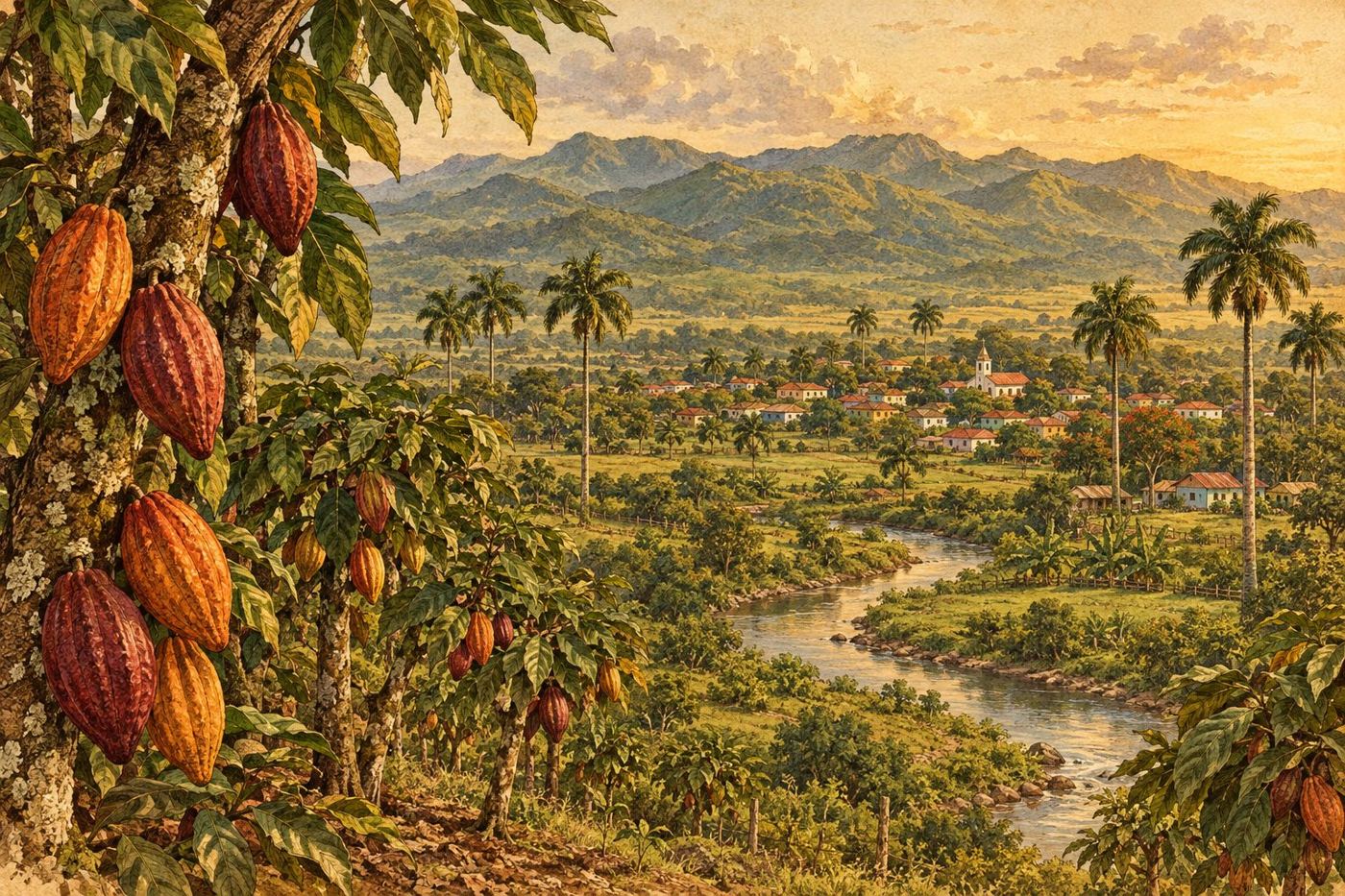
Illustration of the cacao valley of the Nigua river, Castillo
Chapter IV · Feature

Serie 59: the Aquinos of Castillo

A founding surname of a cacao town in Duarte province, and the branch this research cares about most.

Illustration · AI-generated

In the Dominican Republic people often name a hometown by its cédula number. "Soy serie 59" means "I am from Castillo". This feature explains where that number comes from, what the records say about the Aquinos of Castillo, and how to tell this branch apart from the country's other Aquino families.

What "Serie 59" means

When the Dominican Republic created the personal identity cédula under Law 247 of 1932, each card, the old librito, carried an individual number and a series tied to the place where it was issued. Women were included from 1940 under Law 390. In 1992 Law 8-92 created the combined cédula de identidad y electoral, and new formats followed in 1998, 2014 and the renewal that began in October 2024.1

Maps of Dominican municipalities still label each town with "name and series". Castillo is 059. Its neighbors are San Francisco de Macorís 056, Pimentel 057, Villa Riva 058, Arenoso 119 and Las Guáranas 143.2 The series lives on in the first three digits of modern cédulas. In a 2017 staff record of the Castillo town hall, 134 of 149 employees held cédulas beginning with 059.3 The local news outlet Serie59.com takes its name from the same code.4

An important caveat

A series shows where a cédula was issued. It does not show lineage. Two Aquinos with 059 cédulas may be unrelated, and a Castillo-born Aquino who registered in Santiago or New York will carry a different prefix. "Serie 59" is a good shorthand for the Castillo branch, but each family's connection still has to be proven with parish and civil records.
Interactive tool

Cédula series decoder

Type a three-digit series, or the first three digits of a cédula, to see which municipality it belongs to. Nothing you type leaves your browser. The data comes from the municipal series map.2

Castillo: a short history

Castillo lies in the lower Cibao, about 33 km from San Francisco de Macorís, in the valley of the short Nigua River. The river rises at Loma del Firme in the Cordillera Septentrional and joins the Yuna near Hostos.56 The municipal history says the area was first settled around 1718 by contraband traders working the northeast coast.7 A local history describes waves of settlers between 1718 and 1730, coming from San Francisco de Macorís, Salcedo, Moca and La Vega, along with some foreigners.6

1718–1730

First settlement of the Nigua valley

Cattle ranches, rice, cacao and coffee spread through the valleys and savannas.76

1812

Aquinos in the Macorís census

Pedro and Francisca Aquino were counted in the Partido de las Guásumas, within the jurisdiction that then included the Castillo area.8

c. 1884

Cacao and coffee arrive

Historian Juan Alberto Duarte Gómez credits Gregorio Rivas, Doroteo Tapia, Domingo Ferrera and Juanico Aquino.7

1885

A section of San Francisco de Macorís

On 11 March, residents of Nigua, La Ceiba, Maguá and Jaiguá petitioned for a puesto cantonal.57

1889

The Cantón de Juan Díaz moves

The settlement moved to the east bank because of malaria.5

1896

Distrito municipal of Pacificador

The area became a municipal district of the new Pacificador province.7

1897

Coffee on the Nigua and Bracito

A local account says Juanico Aquino and Gregorio Riva planted coffee on a ranch between the two rivers.6

9 Sep 1907

Municipality of Castillo

The town was named for the patriot Manuel María Castillo.79

1925

Pacificador becomes Duarte

The province took its current name.7

1945

Banana exports

Carts carried bananas to the Hostos railhead for shipment through the port of Sánchez.6

2022

Census

The census counted 16,786 residents on 133.1 km², with 10,287 of them rural.79

The Aquino founding family

The Castillo town hall's official history names the town's first families and where they came from:

"Las primeras familias que poblaron Castillo eran oriundas de Santiago, Moca, La Vega, Cotuí, Sánchez, Samaná, San Juan de la Maguana, Yamasá y San Cristóbal. Sus apellidos eran: Díaz, Mercedes, García, Aquino, Nolasco, De Jesús, Rojas, Rosa, Gálvez, De la Cruz, Antigua y Germán, entre otros."Ayuntamiento Municipal de Castillo, "Historia"7

In English: the first families came from Santiago, Moca, La Vega, Cotuí, Sánchez, Samaná, San Juan de la Maguana, Yamasá and San Cristóbal. The list gives places of origin and surnames separately and does not say which family came from where. So the Aquinos' place of origin before Castillo is an open research question. Three leads are worth following:

  • The Macorís lead. Aquinos were already living in the San Francisco de Macorís jurisdiction in 1812, a century before Castillo became a municipality.8 A local continuity is the simplest explanation.
  • The southern lead. San Cristóbal and Yamasá are on the list of origins. A documented Aquino cluster lived in Sabana Grande de Palenque, San Cristóbal, in the 1880s and 1890s.1011
  • The Cibao lead. Santiago, Moca and La Vega supplied many settlers, and the Aquino name is found across the Cibao.612

Juanico Aquino, cacao and coffee

Juanico Aquino is the best-documented early individual of the branch. The municipal history, citing the Castillo historian Juan Alberto Duarte Gómez, says cacao and coffee were introduced around 1884 by Gregorio Rivas, Doroteo Tapia, Domingo Ferrera and Juanico Aquino.7 Serie59.com tells a narrower version: coffee came in 1897 through Juanico Aquino and Gregorio Riva, planted on a ranch bordered by the Nigua and Bracito rivers, and later spread to other ranches.6

Cacao became the base of Castillo's economy. The municipality now promotes itself as producing some of the best cacao in the world.13

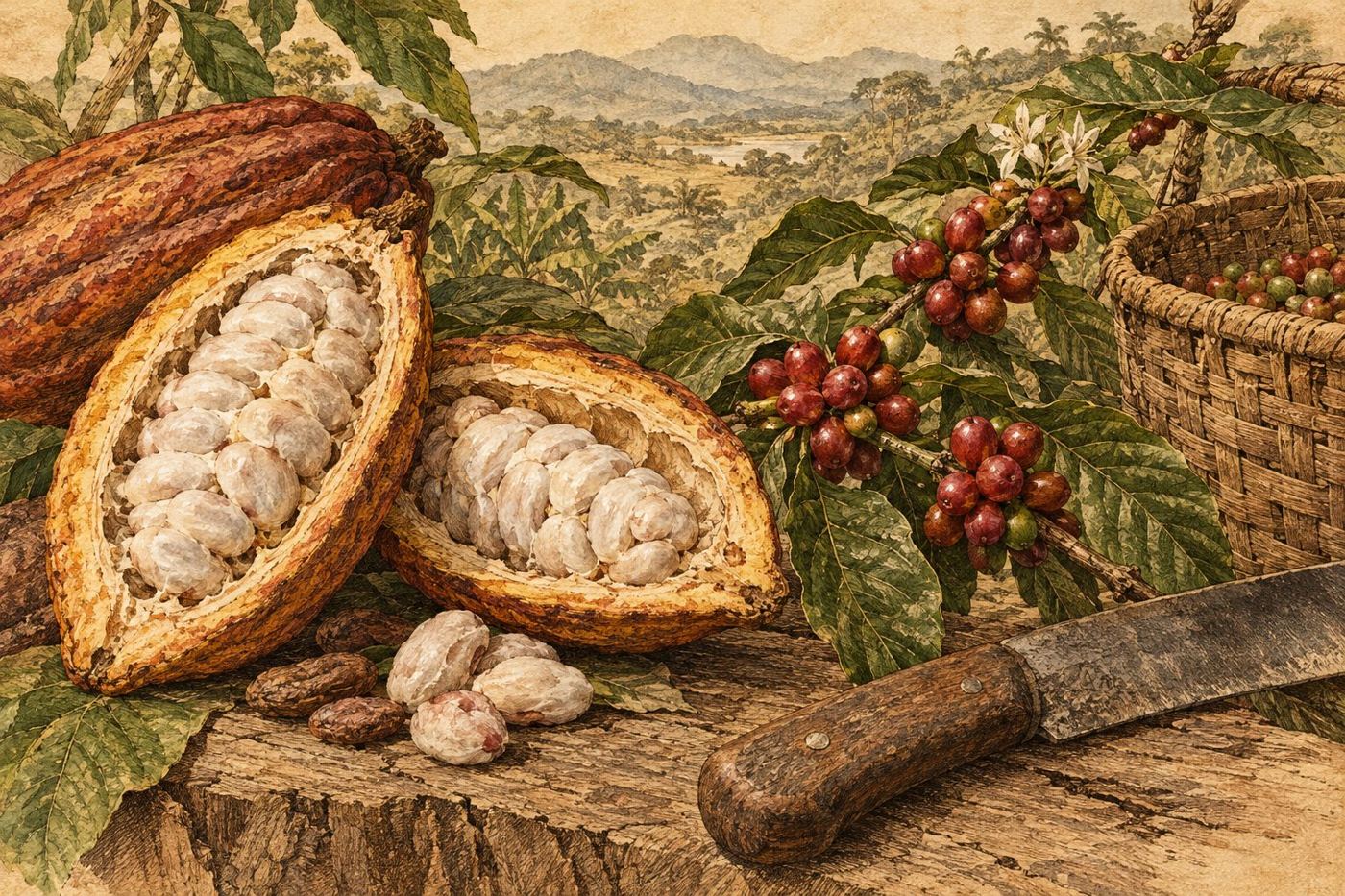
Illustration of split cacao pods and coffee cherries

Illustration · AI-generated

Reconciling 1884 and 1897

The two dates may describe different things. 1884 would be the first cacao and coffee plantings by a group of pioneers, and 1897 the start of a specific coffee ranch. A baptism, marriage or land record naming "Juan Aquino" in the Castillo area would settle it. "Juanico" is a diminutive of Juan.

Aquinos in Castillo today

The surname has stayed in Castillo. Recent public staff records of the Castillo town hall, the 2017 SISMAP file and the 2022 performance evaluation of 207 employees, include people with Aquino as a first or second surname. Their cédulas carry the 059 prefix.314 Out of respect for privacy, this site does not reproduce their names or ID numbers. In the wider province, Ramón Esteban Aquino Arias served as mayor of Arenoso.15 Castillo's current mayor is Faurys Vélez Victorio.16

Where the records are

Record setYearsWhere
Parroquia San Isidro, Castillo (baptisms, marriages)1898–1926FamilySearch catalog17
Oficialía del Estado Civil, Castillo1874–2009; 1896–2005FamilySearch catalog17
Dominican Republic Civil Registration1744–2019FamilySearch collection18
Dominican Republic Births and Baptisms (index)1828–1917FamilySearch collection19
Catholic Church Records, Dominican Republic1590–1975FamilySearch collection20
San Francisco de Macorís parish and civil records (pre-1907 Castillo)variousFamilySearch wiki21
Padrón de San Francisco de Macorís1812Instituto Dominicano de Genealogía8
Interactive

Research plan: proving a Serie 59 Aquino line

Work from the present backward. Tick the steps as you go. Your progress stays on this page until you reload it.

0 of 8 steps complete

How to tell Serie 59 Aquinos from other branches

CluePoints to Castillo (059)Points elsewhere
Cédula prefix059, or neighbors 056, 057, 058, 119, 1432002/083 (San Cristóbal, Palenque), 001 (Distrito Nacional), 034 (Mao), 090 (Sabana Grande de Boyá)
Associated surnamesFounding names: Díaz, Mercedes, García, Nolasco, De Jesús, Rojas, Rosa, Gálvez, De la Cruz, Antigua, Germán7Troncoso, Báez, Encarnación (Palenque line)1011
Place names in family storiesNigua, Bracito, Juan Díaz, La Ceiba, Maguá, Jaiguá, Hostos56Sabana Grande de Palenque, Mao, the capital
OccupationCacao, coffee, rice farming6Varied

Sources cited on this page

  1. Diario Libre — Cómo ha evolucionado la cédula dominicana (2024). History of the Dominican cédula: 1932 Law 247 librito with number and series, 1940 women, 1992 Law 8-92, 2014 format, 2024 renewal. https://www.diariolibre.com/actualidad/politica/2024/01/04/como-ha-evolucionado-la-cedula-de-identidad-y-electoral-dominicana/2568028
  2. Mapa de municipios de la República Dominicana (nombre del municipio y serie). Municipal map listing each municipality with its cédula series number (Castillo = 059). https://www.nalsite.com/imagenes/mapas/pdf/repdominicana/municipios.pdf
  3. SISMAP Municipal — Ayuntamiento de Castillo staff record (2017). Government performance-monitoring evidence file; staff cédulas overwhelmingly begin with 059. https://sismap.gob.do/Municipal/uploads/evidencias/636379628274332675-Ayuntamiento-Castillo.pdf
  4. Serie59.com — Quiénes somos. About page of the Castillo/Duarte news outlet named after the local cédula series. https://www.serie59.com/p/quienes-somos.html
  5. EcuRed — Municipio Castillo (República Dominicana). First settlers, 1885 cantonal petition, Cantón de Juan Díaz, 1907 común. https://www.ecured.cu/Municipio_Castillo_(Rep%C3%BAblica_Dominicana)
  6. Serie59.com — Historia de Castillo. Local news outlet's history page: settlers 1718–1730, coffee introduced by Juanico Aquino and Gregorio Riva. https://www.serie59.com/p/historia.html
  7. Ayuntamiento Municipal de Castillo — Historia. Official municipal history of Castillo, Duarte (founding families, Juanico Aquino, 1907 municipality). https://ayuntamientocastillo.gob.do/historia/
  8. Instituto Dominicano de Genealogía — Padrón de San Francisco de Macorís, 1812. 1812 census capsule: Pedro and Francisca Aquino in the Partido de las Guásumas; a child named Tomás de Aquino. https://www.idg.org.do/capsulas/agosto2008/agosto200816.htm
  9. Wikipedia (es) — Castillo (Duarte). Municipality article: name honors Manuel María Castillo; 2022 census figures. https://es.wikipedia.org/wiki/Castillo_(Duarte)
  10. FamilySearch Ancestors — Gregorio Aquino Báez (1893–1968). Born in Sabana Grande de Palenque, San Cristóbal; father Jerónimo Aquino Troncoso. https://ancestors.familysearch.org/en/KCN9-BVF/gregorio-aquino-baez-1893-1968
  11. FamilySearch Ancestors — Epifanio Aquino Encarnación (1888–1973). Born 1888 in Sabana Grande de Palenque, San Cristóbal. https://ancestors.familysearch.org/en/LY4K-PFM/epifanio-aquino-encarnaci%C3%B3n-1888-1973
  12. Wikipedia (es) — Guarionex Aquino. Dominican baritone from Mao (1924–2010), founder of Radio Santa Cruz. https://es.wikipedia.org/wiki/Guarionex_Aquino
  13. Ayuntamiento de Castillo — 112 años de municipalidad (2019). Anniversary article; Castillo described as home of some of the world's best cacao. https://ayuntamientocastillo.gob.do/castillo-112-anos-de-municipalidad-y-desarrollo-1907-2019/
  14. SISMAP Municipal — Evaluación del desempeño, Castillo 2022. 2022 performance evaluation of 207 municipal staff in Castillo. https://sismap.gob.do/Municipal/uploads/evidencias/638167215265502060-(207)Evaluacin-del-Desempeo-CASTILLO-2022.pdf
  15. Cámara de Cuentas — Funcionarios omisos en la DJP (2016). Lists Ramón Esteban Aquino Arias as alcalde of Arenoso, Duarte. https://camaradecuentas.gob.do/phocadownload/Area_sustantivas/Declaracion_Jurada/Reportes/OMISOS/2016/funcionarios%20omisos%20en%20la%20entrega%20de%20su%20djp.%20actualizado%20al%202%20de%20agosto%20de%202016.pdf
  16. Serie59.com — Alcalde Faurys Vélez Victorio (2026). Current mayor of Castillo. https://www.serie59.com/2026/04/alcalde-faurys-velez-victorio-presenta.html
  17. FamilySearch Research Wiki — Castillo, Duarte Genealogy. Parish and civil-registry holdings for Castillo (San Isidro parish 1898–1926; civil registry 1874–2009). https://www.familysearch.org/en/wiki/Castillo,_Duarte,_Dominican_Republic_Genealogy
  18. FamilySearch — Dominican Republic Civil Registration, 1744–2019. Indexed and image collection of DR civil records. https://www.familysearch.org/en/search/collection/1619814
  19. FamilySearch — Dominican Republic Births and Baptisms, 1828–1917. Index collection. https://www.familysearch.org/en/search/collection/1475794
  20. FamilySearch — Dominican Republic Catholic Church Records, 1590–1975. Parish register images by diocese and parish. https://www.familysearch.org/en/search/collection/1918910
  21. FamilySearch Research Wiki — San Francisco de Macorís Genealogy. Records for the mother municipality of Castillo. https://www.familysearch.org/en/wiki/San_Francisco_de_Macor%C3%ADs,_Duarte,_Dominican_Republic_Genealogy